MANI ASIA SDN. BHD.

Step-by-Step Endodontic Access Preparation: Understanding the Endo Access Workflow

Endodontic access preparation is an important early stage of root canal treatment. The purpose of the access opening is to provide appropriate entry into the pulp chamber and root canal system while allowing the clinician to identify, clean, shape and subsequently obturate the canals. The design and extent of the access should be determined by the individual tooth anatomy, treatment requirements and the clinician’s judgment.

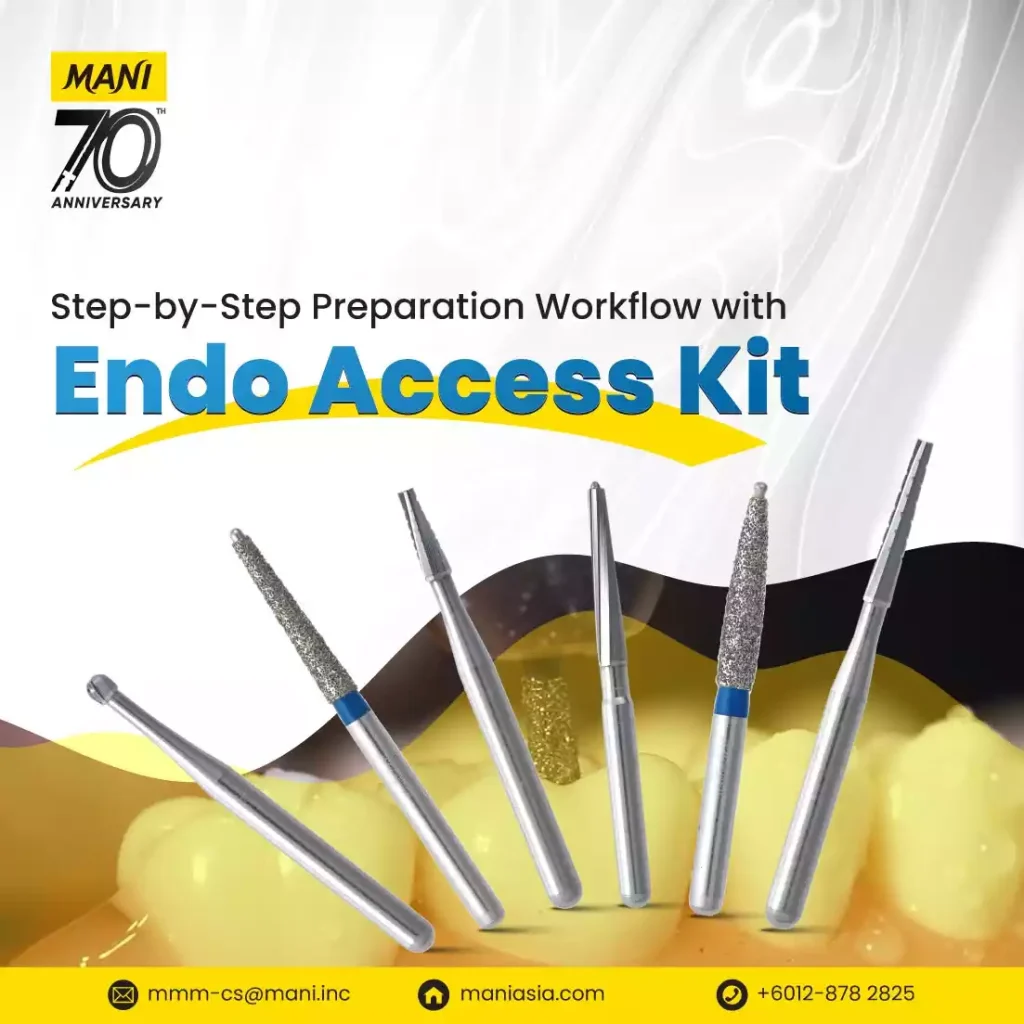
The MANI Endo Access Kit workflow illustrated in this feature presents a three-stage approach: initial penetration of the pulp chamber roof, removal of the chamber roof, and refinement of the access cavity. The sequence is intended to demonstrate how different burs may be used at different stages of access preparation.

It should be understood that the illustrated sequence is a product-specific workflow and should not be interpreted as a universal protocol for every tooth or clinical situation. Clinicians should follow the applicable instructions for use, professional training and accepted endodontic principles when selecting instruments and determining the appropriate access design.

Why Access Preparation Matters

Access preparation establishes the pathway through which the clinician reaches the pulp chamber and root canals. A well-planned access can provide visibility of the chamber and canal orifices while allowing instruments to enter the canal system appropriately.

At the same time, access preparation involves a balance. Removing too little tooth structure may make visualization and instrumentation more difficult, while unnecessary removal of healthy tooth structure should be avoided. Current endodontic literature continues to examine how different access cavity designs influence canal detection, cleaning, shaping, filling and the structural characteristics of treated teeth.

For this reason, the objective is not simply to create the smallest possible opening. Rather, the access should provide adequate working access for the procedure while preserving tooth structure where clinically appropriate. Evidence comparing traditional and minimally invasive access designs remains mixed, and access selection should therefore be based on the clinical case rather than on claims that one design is universally superior.

Step 1: Puncture of the Pulp Chamber Roof

The first stage shown in the MANI workflow is puncture of the pulp chamber roof.

In the illustrated example, the 701 / 701L burs are used to initiate the access. The preparation is demonstrated on a maxillary first molar, with the bur aligned in relation to the long axis of the tooth.

This stage is primarily concerned with establishing the initial pathway toward the pulp chamber. Because tooth anatomy varies between individuals, bur angulation, depth and the extent of preparation should be assessed clinically rather than applied as a fixed measurement to every case.

The clinician’s understanding of the internal anatomy is particularly important during this phase. Radiographic assessment and careful interpretation of the tooth’s external and internal anatomy can help guide access preparation and reduce the risk of unnecessary removal of tooth structure or procedural errors.

The MANI illustration describes a change in tactile sensation when the pulp chamber is reached. However, tactile feedback should be considered together with visual information, pre-operative assessment and other clinical findings rather than used as the sole indicator of chamber entry.

Step 2: Removal of the Pulp Chamber Roof

Once access to the chamber has been established, the second stage focuses on removing the remaining pulp chamber roof.

The MANI workflow illustrates the use of a #3 bur for this stage. The technique shown involves positioning the bur to remove the chamber roof without intentionally extending into the underlying pulp chamber tissues.

The objective of roof removal is to expose the chamber sufficiently for visualization and subsequent instrumentation. An access cavity should provide enough visibility and instrument entry to permit appropriate treatment of the canal system, while avoiding unnecessary removal of surrounding tooth structure.

This step also highlights why access preparation cannot be treated as a one-size-fits-all procedure. Pulp chamber dimensions, chamber position, calcification, restorations, tooth morphology and previous treatment can all influence how the access should be approached.

Accordingly, the burs and technique depicted should be viewed as part of the illustrated MANI workflow rather than as a recommendation that the same sequence must be used in every endodontic case.

Step 3: Pulp Chamber Refinement

The third stage is pulp chamber refinement.

According to the illustrated workflow, the clinician can use the M15EZ, EX-24 and FO-S54 burs to refine the chamber walls and improve access visibility.

Refinement is an important stage because simply creating an opening into the tooth does not automatically result in an optimal access cavity. The chamber should be evaluated for remaining roof, overhangs and areas that may interfere with visualization or instrumentation.

The use of appropriately selected finishing or safety-tip instruments may assist the clinician in refining the chamber while maintaining awareness of the surrounding tooth structure. The exact bur selection and sequence, however, should depend on the tooth being treated and the operator’s clinical assessment.

Modern research on access cavity preparation emphasizes the importance of balancing adequate access with preservation of tooth structure. Studies of minimally invasive approaches have suggested potential advantages in preserving tissue, but some research has also raised concerns about restricted visibility, canal negotiation, cleaning and obturation.

A Balanced Approach to Access Preparation

The discussion surrounding traditional and conservative endodontic access continues to evolve. While preserving tooth structure is an important consideration, an access cavity that is too restricted may make canal identification, instrumentation or cleaning more difficult.

A literature review published in the British Dental Journal concluded that access cavities should provide sufficient removal of chamber obstructions and allow identification of canal orifices while removing as little coronal tooth structure as reasonably necessary. The same review noted that the evidence does not currently support assuming that a conservative access design is always preferable.

This reinforces a practical principle for clinical decision-making: adequate access and preservation of sound tooth structure should be considered together.

The appropriate preparation will vary depending on the tooth, its anatomy, the condition of the pulp chamber, existing restorations and the overall treatment plan.

Where the MANI Endo Access Kit Fits

The three-step workflow shown in this feature provides a structured way of presenting the access preparation process:

1. Initial access
701 / 701L — used in the illustrated workflow to initiate access toward the pulp chamber.

2. Chamber roof removal
#3 — used in the illustrated workflow to remove the remaining roof of the pulp chamber.

3. Chamber refinement
M15EZ / EX-24 / FO-S54 — illustrated for refinement of chamber walls and access visibility.

Together, these stages demonstrate the progression from initial entry to chamber refinement. The workflow also reflects the practical importance of selecting instruments according to the stage of preparation rather than approaching every part of the access cavity in exactly the same way.

However, instrument selection should always remain case-dependent. The presence of calcification, unusual anatomy, restorations, reduced chamber space or other clinical factors may require a different approach.

Clinical Considerations

Endodontic access preparation should be carried out by appropriately trained dental professionals using suitable isolation, visualization and instrumentation. Root canal treatment involves multiple stages beyond access preparation, including canal negotiation, cleaning, shaping, disinfection and obturation.

The instruments shown in this feature are therefore best understood as tools used within the broader endodontic treatment process, rather than as products that independently determine treatment outcomes.

Likewise, it would be inappropriate to suggest that a particular bur sequence can guarantee treatment success, prevent procedural complications or produce a superior clinical outcome in every case. Endodontic outcomes are influenced by multiple factors, including diagnosis, anatomy, treatment planning, operator skill, instrumentation, irrigation, obturation and the final restoration.

Final Thoughts

Effective endodontic access preparation requires more than simply creating an opening into the tooth. It involves understanding tooth anatomy, establishing appropriate access, removing obstructions, maintaining adequate visibility and preserving sound tooth structure whenever clinically appropriate.

The MANI Endo Access Kit workflow illustrated in this feature provides a clear three-stage framework—from initial chamber entry, to roof removal, to final chamber refinement. Used appropriately and in accordance with the relevant instructions for use and professional clinical judgment, the illustrated instruments can form part of an endodontic access preparation workflow.

Ultimately, the goal of access preparation is not to follow a predetermined sequence at all costs, but to create an appropriate pathway for the treatment planned for that specific tooth.


Important Clinical Disclaimer

This article is intended for dental professionals and educational purposes. It does not replace formal endodontic training, clinical judgment, pre-operative assessment, radiographic evaluation, manufacturer instructions for use or applicable professional standards. The workflow shown is an illustration of the MANI Endo Access Kit and should not be interpreted as a universal treatment protocol.


References

  1. American Association of Endodontists. Root Canal Treatment and Root Canal Explained.
  2. American Association of Endodontists. Traditional versus Conservative Access: Where are we Today?
  3. Which endodontic access cavity is best? A literature review. British Dental Journal / PubMed.
  4. Silva EJN et al. Present status and future directions – Minimal endodontic access cavities. International Endodontic Journal.
  5. Mandil OA et al. Modern versus Traditional Endodontic Access Cavity Designs.
  6. Medical Device Authority Malaysia. Code of Advertisement (MDA/GD/0032), Second Edition.


Leave a Comment

Your email address will not be published. Required fields are marked *

Shopping Cart